ARTHUR WOLF / MANGA DISCOVERY
Contents · 12 chapters
  1. The proposition
  2. What a recap is
  3. Why a publisher
  4. What you buy
  5. Work that exists
  6. The production method
  7. Research vs delivery
  8. A concrete example
  9. Editorial and rights
  10. How we judge it
  11. A paid first step
  12. Build the evidence

Arthur Wolf / Publisher review / 2026-10-14

Turn a first encounter
into a first chapter.

Authorized manga discovery videos.
Software-assisted production. Human editorial control.

A paid, bounded pilot for one title—designed to send interested viewers to your official reading or buying page.

Explore the proposal
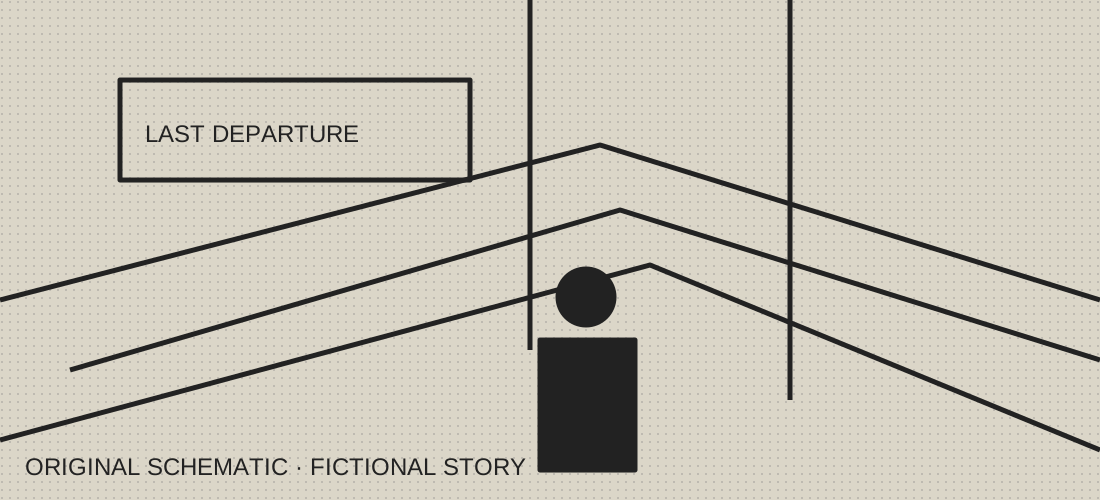
Original schematic of an empty station with one waiting figureFROM PAGE
TO POSSIBILITY
A format concept, not a finished client film
Publisher review · Proposed paid pilot01 / 12

01 / The format

A recap tells enough story
to make someone curious.

Selected panels, a clear narrative, deliberate pacing, sound and captions.

The proposed publisher version introduces a protagonist and a conflict, stops before the resolution, and invites viewers to continue reading. It is an approved excerpt, with an agreed spoiler boundary.
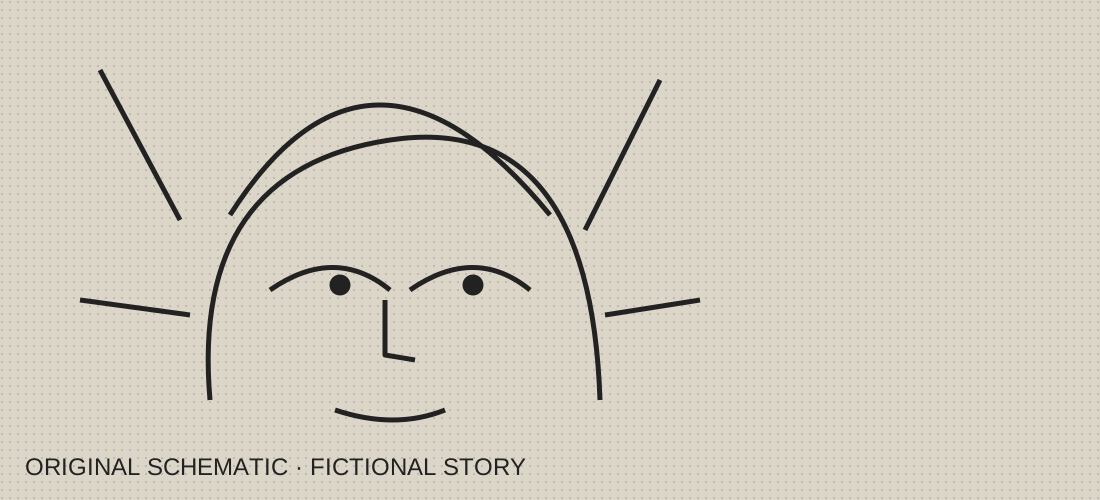
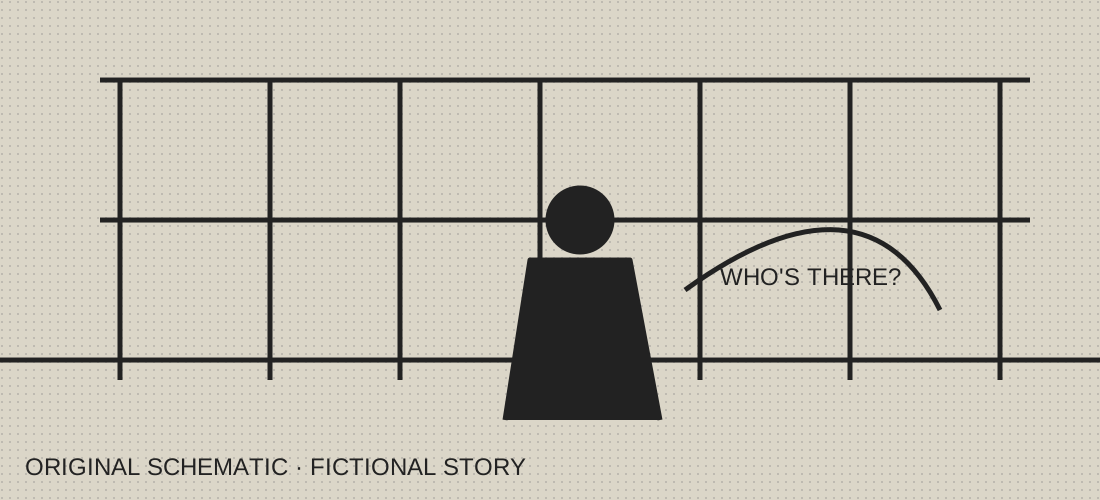
Station setting
01 · Establish the world
Schematic surprised face
02 · Give us a reason to care
Figure confronting an unknown presence
03 · Leave the question open

Fictional schematic sequence. No existing manga is being adapted here.

Publisher review · Proposed paid pilot02 / 12

02 / The buyer outcome

The destination is reading.
The video is the invitation.

A reader-acquisition experiment for a title you can authorize.

Useful for a series launch, a backlist discovery campaign, or an official reading-platform promotion. The publisher supplies its channels or media budget; the offer is creative production, not an assumed influencer audience.

DiscoverApproved video creative
→
ContinueOfficial title destination
→
MeasureQualified reading or purchase
Views are a diagnostic. Reader behavior is the commercial question.
Publisher review · Proposed paid pilot03 / 12

03 / Proposed production scope

One title can become
a coherent creative package.

A proposed 90–180 second landscape teaser, two vertical cutdowns, and two opening-hook variants.

Captions, approved narration and music, a thumbnail, and a title-specific call to action. One language and territory; two bounded rounds of consolidated feedback.

Final scope follows feasibility. Distribution, ad spend, outside talent, further languages and engine/source-code transfer are separately agreed.

Schematic landscape teaser16:9 · MAIN TEASER
Schematic vertical cutdown9:16
CUTDOWN
Video exportsSRT captionsMeasurement brief
Publisher review · Proposed paid pilot04 / 12

04 / Source-grounded evidence

There is a real foundation.
Production readiness is still open.

The July 2026 manga archive contains an editor and processing/rendering code.

Page and panel tools, a scene-node editor, timeline controls, crop/pan operations, audio rendering and an FFmpeg video renderer are present in the inspected source.

No finished manga recap export or current runtime test was found in the inspected archive. Existing code is evidence of engineering work; it is not evidence of reliable delivery today.

SOURCE INSPECTED

Scene graph

input_image → start_rect / end_rect → output_animationSceneNodePan.ts · on_create / on_dirty
SOURCE INSPECTED

Frame + audio assembly

frames.txt + audio.wav → FFmpeg → output.mp4VideoRenderer.ts · render()
NOT RUNTIME-VERIFIED

Editor + timeline

PageEditor.vue · scene_editor.ts · TimelineEditor.vueArchived application; no live product claim
Publisher review · Proposed paid pilot05 / 12

05 / Technology, with boundaries

Make editorial decisions
explicit before rendering.

A reviewable chain from approved source to approved film.

Page understanding suggests panels, bubbles and ordering. A person checks the interpretation, writes or approves the story, and sets pacing. A scene graph keeps image treatments and timing inspectable.

The archived source contains detection and scene processing code. Accuracy, present integrations and repeatability still require validation.

Cleared inputsPages, language, use
Analyze + correctPanels, text, identity
Approve the storyScript + spoiler limit
ComposeCrop, pan, timing, audio
Review + exportCaptions, playback, CTA

Proposed production workflow, grounded in the archive’s existing module boundaries.

Publisher review · Proposed paid pilot06 / 12

06 / Honest development status

Editable reconstruction is
a research track, not a promise.

The current drawing project contains a design conversation and implementation plan.

It proposes mixed semantic, procedural and raster layers; a frozen eye-template experiment; and assisted bubble cleanup. The inspected project contains planning documents, not an implemented reconstruction engine.

Hidden pixels would be inferred or generated—not recovered original artwork. This research is optional to a conservative pilot using approved source art.

Observed source pixels Preserve
Panel / bubble / text structure Interpret
Procedural templates + residual Experiment
Occluded content completion Infer / label
The test: does reusable structure reduce real correction work while preserving protected pixels?
Publisher review · Proposed paid pilot07 / 12

07 / Fictional creative treatment

Stop where the reader
wants the next page.

“The last train has left.
Then a voice calls from the dark.”

Open on the setting, move closer to the character’s reaction, then reveal an unresolved encounter. End with the official title name and a clear invitation to read.

Illustrative invented story and motion treatment. A real pilot would use only a publisher-approved script and assets.

Fictional station sequence frame
The last train has left.
No audio · three frames
Publisher review · Proposed paid pilot08 / 12

08 / Publisher control

Your story stays
under your approval.

Agree the permissions and the creative boundaries before production.

Title-specific pages, translation, adaptation, edits, platforms, territories, term and paid/organic use. Approve model services and data handling. Keep the default artwork original to the title; no replacement drawings or cloned voices without specific agreement.

01Rights + source package

Named approval owner; portfolio use agreed separately.

02Script + storyboard

Character names, pronunciation and spoiler stop checked.

03Final edit + release

Accurate narration, readable captions, working destination.

Publisher review · Proposed paid pilot09 / 12

09 / A measured experiment

Accept the film on quality.
Evaluate the campaign on readers.

Choose the primary outcome before launch.

For a reading platform: cost per qualified new reader reaching an agreed chapter milestone. For direct sales: attributable purchases and contribution. Track the observable funnel, compare with existing creative under similar conditions, and report insufficient traffic honestly.

Production acceptance uses approved story accuracy, cleared rights, agreed files and tested links. No guaranteed views, conversion or sales.

Impressions Reach
Retention / completion Attention
Outbound / landing visits Intent
Reading starts / milestone Qualified reader
Paid conversion, if visible Commercial result

No results yet. These are measurement stages, not reported metrics.

Publisher review · Proposed paid pilot10 / 12

10 / Commercial next step

Fund a useful proof.
Then make a go/no-go decision.

Start with a capped, paid feasibility milestone.

You provide one cleared title, a marketing owner, source assets and a destination. Arthur delivers a creative outline, a short proof sequence, a rights/data workflow and an honest production estimate.

Price follows scope and sustainable effort. Any further development is funded separately; reusable engine IP and client usage rights are explicitly agreed.

PAID MILESTONE 1

Feasibility

Approved outline
Short proof
Remaining work + quote

IF APPROVED

Production

One-title package
Human review
Agreed exports

IF RELEASED

Campaign

Client distribution
Measured comparison
Expand, revise or stop

Publisher review · Proposed paid pilot11 / 12

11 / Review before outreach

The next illustration
should be an actual cleared proof.

Approve the proposition. Select permitted material. Build one convincing sequence.

A cleared sample is the missing sales evidence. Publisher outreach remains conditional on Arthur approving this presentation; no messages or forms have been sent.

Inspect the evidence notes

20–30 second proof

Source panel → timed edit → official reading invitation.

Editor walkthrough

Real scene graph and timeline, with rights-cleared input.

Correction comparison

Raw interpretation → human fix; log actual effort.

Pilot scorecard

Real funnel and correction costs after an agreed test.

Publisher review · Proposed paid pilot12 / 12

Evidence, provenance & practical limits

A proposal you can audit.

This review is grounded in the inspected local manga archive, the current drawing research plan, and the paid-pilot business review dated 2026-10-14. No customers, endorsements, publisher budgets, campaign metrics or production readiness have been invented.

What the inspection establishes
  • Existing source: manga.zip contains PageEditor, a Rete-based scene editor, TimelineEditor, detection scripts, scene-node processors and audio/video renderers. Source inspection only; the archived application was not started.
  • Planned research: drawing/docs/implementation-plan.md describes eye-template fitting, protected-region preservation and assisted bubble cleanup. No implementation was found in that project.
  • Not established: a current end-to-end manga recap, reliable analysis accuracy, cleared sample footage, scalable cost, a paying client, or conversion lift.
Why this public version uses schematics

The inspected manga archive contains code but no image/video assets. Related comics imagery in the broader workspace was not shown to have public promotional rights. This deck therefore reuses the actual module relationships and named source artifacts as visual evidence, and uses original, clearly labeled SVG schematics for story examples. It does not claim to show a finished manga-project film or an actual product screenshot. The local construction folder records sources and publication decisions. Cleared project screenshots and a real sample remain the next useful additions.

Measurement and distribution details

Test destination links, analytics and channel permissions before release. A URL drawn inside a video is not itself clickable. Ordinary Shorts description/comment URLs are not clickable; eligible long-form links and account-specific features need checking. Permission to use manga does not guarantee channel monetization.

YouTube link guidance · End-screen requirements · Monetization policy

Campaign acceptance and production payment are separate. Compare title, audience, placement and spend; agree the minimum useful sample and analysis window. A small test may be inconclusive. Check production plus media cost against incremental customer contribution using the buyer's actual economics.

Commercial qualification after Arthur approves

Identify the marketing budget owner and rights owner, a suitable continuing title, an accessible official destination, distribution channels, analytics access and a funded bounded scope. The business review names potential prospects, not committed customers. No outreach has occurred.

Presenter notes

The proposition. Lead with the reader acquisition proposition. No customers, budgets or outcomes have been established.

What a recap is. Narration, timing and panel selection are editorial choices. Do not imply that these schematic frames were generated by the archived engine.

Why a publisher. This is a hypothesis to test against existing creative, not an established conversion advantage.

What you buy. These are proposed deliverables, not a fixed production promise before a proof sequence establishes readiness.

Work that exists. Source paths refer to manga.zip contents. The renderer currently has a 10 fps setting and 1920×1080 frame merge. This is not a claimed campaign specification or a new run.

The production method. AI vendors and retention/training settings must be agreed before client pages enter a third-party service. Manual or approved local processing remains a possible fallback.

Research vs delivery. drawing/docs/implementation-plan.md is evidence of a plan. Do not claim that eye fitting, bubble removal, whole-page reconstruction or character animation is demonstrated.

A concrete example. This tiny browser sequence illustrates editorial pacing, not the archived engine. It has no synthetic voice, music, manga pages or render-performance claim.

Editorial and rights. This describes required workflow gates rather than giving title-specific legal advice. A reading license alone does not establish video, ad or AI-processing permission.

How we judge it. Pre-agree sample size and campaign window from actual baselines. Use randomized/platform split testing where possible. Also record correction hours, cost, failure types and repeatability.

A paid first step. No invented price, established publisher budget or signed client. The first actual commercial validation is a budget owner agreeing to pay for a bounded scope.

Build the evidence. Further illustrations are proposals. Do not publish private correspondence, uncleared full manga/anime imagery, or generated hidden content described as recovered original pixels.

Icons use Tabler outline geometry (MIT). Original schematic SVGs created for this review. Public review URL: anyone with the URL can view it; noindex is a search preference, not access control.